What sensitive skin usually reacts to
Sensitive skin is not a single diagnosis. Dermatology-oriented consumer sources describe it as skin that is more reactive than average, showing up as redness, burning, dryness, itching or stinging — sometimes within minutes of application, sometimes after days of repeated use. Because the label describes a pattern of reactions rather than one condition, two people with "sensitive skin" may react to completely different things.
In practice, the reactions people report cluster around a few common causes. Harsh or stripping cleansers, alcohol-heavy toners, aggressive exfoliation, sulfate surfactants such as SLS and SLES, and added fragrance are the categories most often named in consumer-facing coverage of reactive skin.
It is also worth remembering that irritation is often cumulative rather than instant. Over-cleansing, layering several active products at once, and repeatedly restarting strong treatments are described as common triggers — the reaction is frequently the result of a routine that is too much at once rather than one uniquely bad product.
- Redness, burning, stinging, itching or tightness after application
- Flare-ups that build over days of repeated use rather than appearing immediately
- Reactions tied to cleansing habits and product layering, not only to single ingredients
Sources: Topical Skin, Alpyn Beauty, Credo Beauty, Gentle Skin Essentials
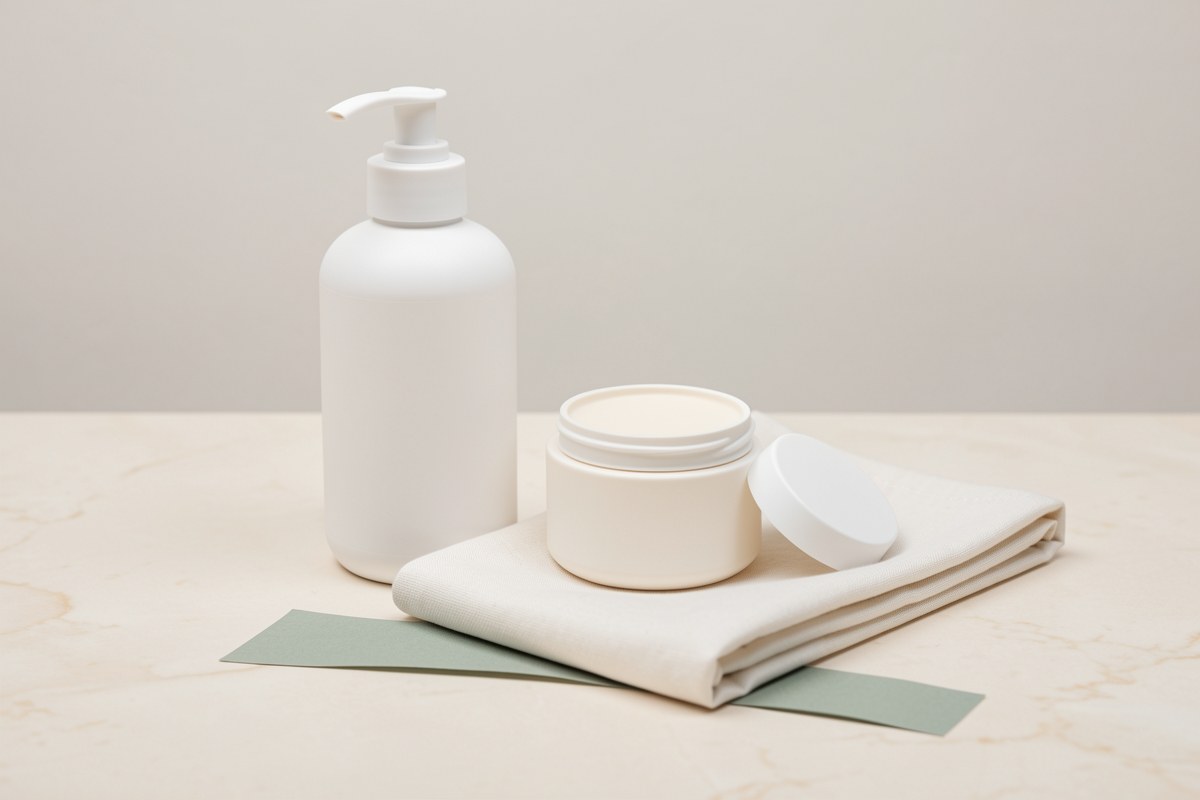
Choosing gentle cleansers and moisturizers
Cleansing is where most reactive-skin routines get into trouble, because it is the step people do twice a day and the step most likely to leave skin feeling tight. The consistent advice is to look for non-stripping, barrier-supporting formulas: think cream, lotion or mild gel textures rather than foaming scrubs, and skip anything that leaves your face feeling squeaky.
Moisturizer is the other half of the foundation. Hydration-supporting ingredients such as ceramides, glycerin and hyaluronic acid come up repeatedly in consumer-facing recommendations for reactive skin. These are widely used humectants and barrier components, and they are reasonable things to look for — but it is worth being honest that the available coverage does not establish specific concentrations or prove that any single one of them will calm your particular skin.
A practical way to think about it: buy one cleanser and one moisturizer that are as plain as you can tolerate, use nothing else for a while, and only then decide whether you need more steps. A calming toner or essence is optional, not mandatory.
- Cream, lotion or mild gel cleansers instead of foaming or exfoliating washes
- Moisturizers built around ceramides, glycerin or hyaluronic acid
- Skip toners with high alcohol content and anything that stings on contact
- One cleanser plus one moisturizer is a complete starting routine
Sources: Alpyn Beauty, Trendy Look Blog, Skin Elite
Makeup formats with fewer irritants
Makeup gets less attention than skincare in sensitive-skin advice, but the same logic applies: format and application matter as much as the ingredient list. Products you leave on all day — foundation, concealer, long-wear lip color — have more contact time than a cleanser you rinse off in thirty seconds, so they deserve the same caution.
Broadly, the formats that tend to suit reactive skin are the ones that are simpler and less actively exfoliating: cream or stick formulas over heavily fragranced powders, mineral or fragrance-free foundations over heavily perfumed ones, and traditional lipsticks over plumping or tingling lip products. Anything marketed around a warming, cooling or tingling sensation is doing something to your skin on purpose, and that sensation is often the first thing a reactive face will object to.
If you wear makeup most days, the more useful question is not "which brand is for sensitive skin" but "how many fragranced products am I layering on the same area?" Reducing that number is often more effective than switching brands.
- Favor cream and stick textures over heavily fragranced powders
- Choose fragrance-free or mineral-based complexion products
- Avoid plumping, tingling or warming lip and cheek formulas
- Consider how long each product stays on your skin, not just its ingredients
Sources: Topical Skin, Alpyn Beauty
Label terms to prioritize and to question
Label language on beauty products is a useful filter, but it is not a guarantee, and it is worth knowing which terms carry real weight and which are looser than they sound.
Terms worth prioritizing include fragrance-free, dye-free, non-comedogenic, and short ingredient lists. Terms worth questioning include "natural," "organic," "clean," and "hypoallergenic." Consumer sources note that natural and organic labels are loosely regulated, and that hidden fragrance allergens can be present even in products positioned as gentle. "Hypoallergenic" is not a standardized promise that a product cannot cause a reaction in you personally.
The single most important caution: fragrance-free is not the same as free of fragrance chemicals. A product can contain individual aromatic ingredients that function as fragrance without being listed under the word "fragrance." If your skin reacts to scent families, a short and specific ingredient list is more informative than a marketing claim on the front of the box.
Regulatory questions about exactly what these terms mean legally in the United States are not settled by the consumer sources available here, so treat label claims as a starting filter rather than a final answer.
- Prioritize: fragrance-free, dye-free, non-comedogenic, short ingredient lists
- Question: natural, organic, clean, hypoallergenic
- Remember that "fragrance-free" does not automatically mean "no fragrance chemicals"
- Read the ingredient list, not just the front-of-pack claim
Sources: Topical Skin, Trendy Look Blog
Building a minimal routine for reactive skin
The routine-building advice for reactive skin is consistent and almost boring: start with less, add one thing at a time, and give your skin room to tell you what it thinks. Consumer sources describe introducing a single new product while everything else stays the same, so that if a reaction happens you know what caused it.
Patch testing is the standard first step. A commonly described approach is to apply a small amount of the new product to clean, unbroken skin on the inner forearm and leave it for about 24 hours, checking for redness, itching or swelling. If the patch area is calm, some sources then suggest a trial on a small area of the face before using it everywhere. Exact durations vary between sources, and there is no single standardized protocol — the point is to test somewhere visible and low-risk before committing your whole face.
How long should the whole process take? One consumer source suggests that establishing tolerance for a full sensitive-skin routine can take several months, citing a three-to-six month window. That timeframe comes from a single source and should be treated as reported guidance rather than a rule. What matters more is the pattern: one product at a time, a patch test first, and no rushing to add actives because progress feels slow.
- Strip back to a basic cleanser and moisturizer you already tolerate.
- Patch test any new product on the inner forearm for about 24 hours.
- If the patch area stays calm, try a small area of the face before full-face use.
- Add only one new product at a time and keep everything else unchanged.
- Wait long enough to judge the result before adding the next product.
- Repeat with the next product only after the current routine is stable.
Sources: Alpyn Beauty, Credo Beauty, Gentle Skin Essentials
Exfoliants, actives and other higher-risk steps
Exfoliants and concentrated actives are where sensitive skin is most likely to be pushed too far, and the consumer sources are cautious about them rather than encouraging. Aggressive exfoliation is repeatedly named as a trigger for reactive skin, alongside harsh cleansers and alcohol-based toners.
That does not mean exfoliation is permanently off the table. It means it belongs near the end of the process, not the beginning. The sensible sequence is to get a stable, minimal base routine working first, then consider one gentle exfoliating product at low frequency, introduced on its own so you can attribute any reaction correctly. Physical scrubs with coarse particles and strong acid treatments are the formats most often flagged as risky for reactive skin.
If your skin is currently in an active flare — red, stinging, raw — that is not the moment to start experimenting with exfoliants at all. Calm first, then reassess. And if a product causes significant burning, swelling or a spreading rash, stop using it and get medical advice rather than trying to "push through."
- Get a stable cleanser-and-moisturizer routine working before adding any exfoliant
- Choose one gentle exfoliating product rather than layering several
- Introduce it alone and at low frequency so reactions can be attributed
- Skip coarse physical scrubs and strong acid treatments while skin is flaring
Sources: Topical Skin, Alpyn Beauty, Trendy Look Blog
When to consult a professional instead
Self-directed product selection has limits, and sensitive skin is a symptom pattern rather than a diagnosis. If your skin is persistently red, swollen, oozing, or painful, if reactions are spreading beyond where you applied the product, or if a patch test produces a strong reaction, that is a sign to stop experimenting and see a licensed clinician.
The same applies if you have tried the minimal-routine approach for a reasonable period and your skin is not settling, or if you suspect you are reacting to something you cannot identify. Persistent or worsening symptoms can have causes that no amount of label-reading will resolve, and diagnosing them is a job for a medical professional.
To be clear about the boundary here: this guide is about choosing products, not about treating a skin condition. Any decision about diagnosis, treatment or prescription belongs with a licensed clinician who can examine your skin.
Sources: Topical Skin, Alpyn Beauty
Putting the decision together
No checklist removes the need to test on your own skin, but it does make the choice between two products a little faster. When a decision is genuinely close, pick the simpler formula and the slower introduction schedule — those two habits cover most of the ground that any specific ingredient choice would.
| Decision point | Lower-risk choice | Higher-risk choice |
|---|---|---|
| Cleanser texture | Cream, lotion or mild gel | Foaming, scrubbing or exfoliating wash |
| Surfactants | Sulfate-free formulas | Products listing SLS or SLES |
| Fragrance | Fragrance-free, dye-free | Heavily perfumed products |
| Moisturizer | Ceramides, glycerin or hyaluronic acid | Alcohol-heavy toners or astringents |
| Makeup | Cream or stick, fragrance-free | Tingling, plumping or warming formulas |
| Introduction pace | One new product at a time, after a patch test | Several new products at once |
| Exfoliation | Deferred until the base routine is stable | Aggressive scrubs or strong acids during a flare |
Sources: Topical Skin, Alpyn Beauty, Credo Beauty, Trendy Look Blog, Gentle Skin Essentials, Skin Elite
Frequently asked questions
Can sensitive skin use exfoliants?
Sometimes, but they belong late in the process rather than early. Build a stable cleanser-and-moisturizer routine first, then consider a single gentle exfoliating option at low frequency, added on its own so you can tell what caused any reaction. Aggressive exfoliation is repeatedly named by consumer sources as a trigger for reactive skin, and coarse scrubs or strong acids are a poor choice during an active flare.
Sources: Topical Skin, Alpyn Beauty, Trendy Look BlogHow long should I trial a new product on sensitive skin?
There is no single standardized timeline. A commonly described approach is a patch test on the inner forearm for about 24 hours, followed by a trial on a small area of the face before full-face use. After that, give the product enough time to show its effect before you change anything else. One consumer source suggests establishing tolerance for a whole sensitive-skin routine may take several months, but that figure comes from a single source and is best treated as reported guidance rather than a rule.
Sources: Alpyn Beauty, Credo BeautyShould I avoid all essential oils?
Not necessarily all of them, but they deserve scrutiny if your skin is reactive. Added fragrance is one of the ingredient categories most often linked to irritation, and essential oils are aromatic plant ingredients that can act as fragrance allergens even in products marketed as clean or natural. If you notice reactions to scented products generally, a fragrance-free formula with a short ingredient list is the more predictable choice.
Sources: Topical Skin, Trendy Look BlogIs a fragrance-free product guaranteed not to irritate?
No. Fragrance-free is not the same as free of fragrance chemicals — individual aromatic ingredients can be present without being listed under the word fragrance. Consumer sources also note that natural and organic labels are loosely regulated, and that hidden fragrance allergens can appear even in gentle-looking products. A fragrance-free label is a useful filter, not a personal guarantee.
Sources: Topical Skin, Trendy Look BlogWhich cleansers are suitable for reactive skin?
A dermatologist-authored social post recommends Avene Tolérance Control Cleanser, Vanicream Gentle Facial Cleanser and La Roche-Posay Lipikar Wash as options that avoid harsh actives, fragrance and dyes. That recommendation comes from a single social post, so it is worth treating as one professional's suggestion rather than an independent ranking. Beyond named products, the consistent advice is a non-stripping cream, lotion or mild gel cleanser.
Sources: Instagram / Dr. Patricia Oyetakin, MD, FAADWhy does my routine sometimes irritate my skin even when each product seemed fine?
Because irritation is often cumulative. Over-cleansing and layering too many new or strong products at once are described as common triggers in reactive skin, meaning the problem may be the combination and pace rather than any single product. This is the reason consumer sources recommend one new product at a time against a stable base routine.
Sources: Topical Skin, Alpyn Beauty, Gentle Skin EssentialsDo I need a toner, serum and essence as well as a cleanser and moisturizer?
No. A minimal routine of one gentle cleanser and one moisturizer is a complete starting point, and additional steps are optional. Some consumer sources describe a soothing cleanser, gentle toner and balancing moisturizer as a reasonable sequence, but the more important principle is keeping the number of products low enough that you can identify what your skin is reacting to.
Sources: Gentle Skin Essentials, Skin EliteWhen should I stop choosing products myself and see a clinician?
See a licensed clinician if your skin is persistently red, swollen, oozing or painful, if reactions spread beyond the area where you applied a product, if a patch test produces a strong reaction, or if a careful minimal routine is not settling your skin over time. Diagnosing a skin condition is a medical task and falls outside what product selection can resolve.
Sources: Topical Skin, Alpyn BeautySources
- How to Choose Skincare for Sensitive or Reactive Skin – Topical Skin — Topical Skin
- Clean Beauty Routine for Sensitive Skin – Alpyn Beauty — Alpyn Beauty
- Clean Skin Care For Sensitive Skin | Credo Beauty — Credo Beauty
- 3 Best Fragrance-Free Cleansers For Reactive Skin — Trendy Look Blog
- Instagram — Instagram / Dr. Patricia Oyetakin, MD, FAAD
- Best Skincare Products for Sensitive Skin | Gentle Skin Essentials — Gentle Skin Essentials
- Skin Care Products for Sensitive Skin | Skin Elite — Skin Elite